Japanese conglomerates like Panasonic, Hitachi, Daikin and other Japanese businesses have been at the forefront of a government-backed campaign to adopt a new metric to assess a company’s efforts towards achieving carbon neutrality goals. This metric is avoided emissions, sometimes called scope 4 emissions. It is based on the idea that investors should look beyond a company’s efforts to reduce greenhouse gas (GHG) emissions in its own operations and supply chains to consider the contributions made to society and the economy by its energy-saving products and services.
So, what do avoided emissions mean? Avoided emissions refer to reducing greenhouse gas emissions that occur outside of a product’s life cycle or value chain but as a result of using that product. Thus, using an electric vehicle helps reduce carbon emissions even though the product itself may have high scope 1 and 2 emissions. The emissions avoided by the use of the product are currently not considered.
Thus, companies like Tesla are ranked low on emissions even though they help reduce emissions by enabling people to shift from petrol. Other examples of avoided emissions include such products and services include low-temperature detergents, fuel-saving tires, energy-efficient ball-bearings, teleconferencing services, manufacturing a catalyst to improve production efficiency, providing services enabling energy savings, selling digital technologies that reduce the need for business travel, and using clean-burning fuel and avoiding idling to cut carbon emissions.
How can avoided emissions be measured? A simple approach is to measure the difference between the total life-cycle GHG inventories of a company’s product (the “assessed” product) and an alternative (or “reference”) product that provides an equivalent function. Then the
Comparative GHG Impact = Life-Cycle Emissions of Reference Product – Life-Cycle Emissions of Assessed Product
Here the reference product may be a petrol vehicle, and the assessed product is the electric vehicle. If the comparative impact is positive, then the petrol vehicle emissions are higher than that of electric vehicles, and there is avoided emission. The key challenge here is finding a comparable reference product.
There is a strong case for measuring avoided emissions. It can bring a competitive advantage by showing that a product is environmentally friendly. It also increases the level of transparency in its non-financial disclosures. By providing goods and services with low carbon emissions the company supports decarbonising efforts. Once a standardised measurement method is made available, it will be easy to compare products and services.
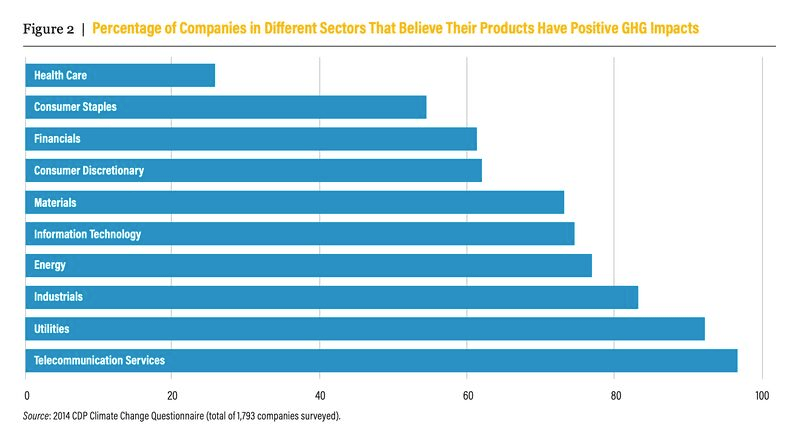
Image: from Estimating And Reporting The Comparative Emissions Impacts Of Products, World Resources Institute Working paper
 Utkarsh Majmudar