

ESG Investing and AI

Artificial Intelligence (AI), machine learning, and natural language processing have taken a firm foothold, and companies are exploring opportunities to leverage their power. ย AI and related tools will help investors navigate companiesโ€™ financial performance prospects and environmental, social and governance (ESG) factors.

Letโ€™s look at some of the ways in which AI can support ESG investing:

Data standardization: AI can standardize and validate data from multiple sources, providing a more consistent and transparent view of ESG performance.

Data analytics: AI can collect and process large amounts of ESG data. This can help companies identify trends and track performance, resulting in improved investor decision-making.

ESG Ratings: AI can automate the analysis of diverse ESG datasets by creating standardised frameworks. This helps investors to compare and evaluate ESG performance consistently.

Portfolio construction: AI can help investors construct well-diversified portfolios. These portfolios not only align with sustainability goals but also seek to generate competitive financial returns.

Risk assessment: AI can assess a company’s exposure to ESG risks, such as climate change, labour practices, and corporate governance.

Investment theses: AI can help firms create their own investment theses. They can use standardized and detailed taxonomies and materiality maps to refine their weighting of a large number of quantitative ESG sub-metrics.

While AI can bring tangible efficiencies in ESG investing there are several risks that need to be kept in mind. The quality of underlying data is always a concern. Garbage in Garbage out (GIGO) is a well-known technology risk. AI models are susceptible to biases in training data. Many of the ESG factors are complex and correlated. It needs an expert hand to make sure that they do not lead to misleading results. The use of AI raises ethical concerns, including privacy, data security, and the responsible use of technology.

While AI can enhance decision-making, it is important to strike the right balance between human judgment and AI-driven insights.
๐‚๐ฅ๐ข๐ฆ๐š๐ญ๐ž ๐Ÿ๐ข๐ง๐š๐ง๐œ๐ž: ๐๐ž๐ฒ๐จ๐ง๐ ๐ฎ๐ซ๐ ๐ž๐ง๐ญ

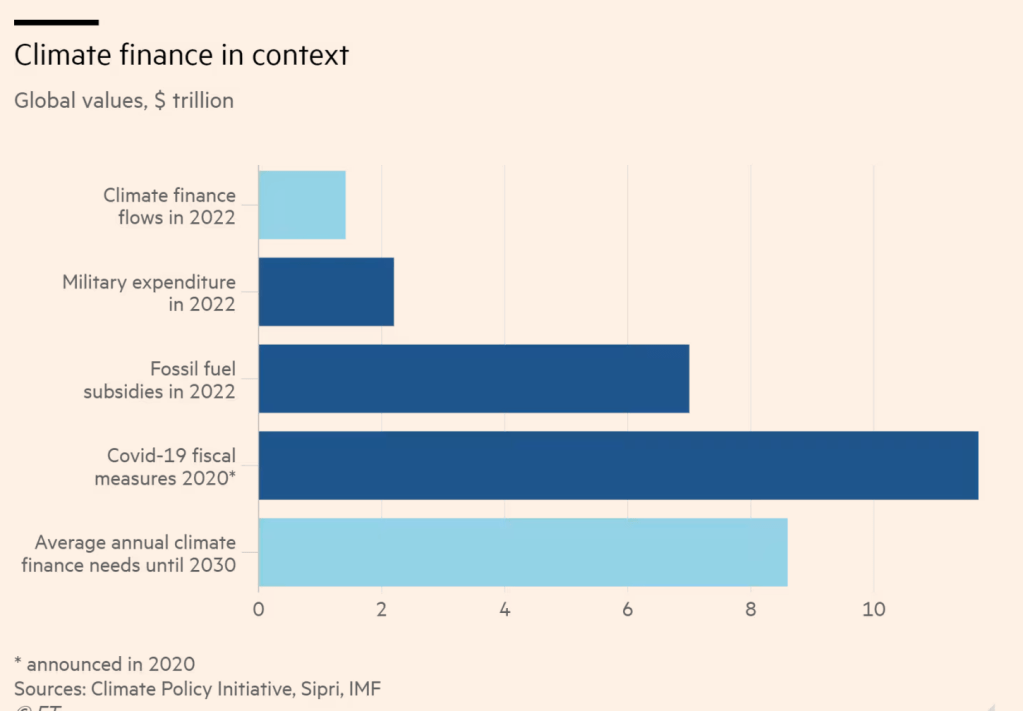
We are at the doorsteps of 2030, the year designated to reduce the global temperature increase to 1.5ยฐC, and the picture is gloomy. Finance is a critical ingredient to saving our planet. And it seems to be in short supply. According to the IMF,ย the Asia-Pacific region faces a climate financing shortfall of at least $800 billion.ย The UN says that developing countries need at least ten times more money to adapt to the effects of climate change than they currently receive.ย The OECD estimates that developing countries will need around $2.4 trillion annually for climate investments between 2026 and 2030. A graphic (below) from a recent Financial Times article caught my attention. The climate finance flows in 2022 were a quarter of the annual climate finance needs till 2030. More money seems to have been spent on military and fossil fuel subsidies than on climate.

Source: Financial Times

Is this likely to change? Unlikely. In 2024, 49% of the worldโ€™s voters will vote in elections across 64 countries. Most of the world is still struggling with economic woes, and many of the largest economies face budget deficits. Many industries are trying to come to terms with the economic reality. Thus, there is a shortage of both public and private funds.

Governments and private investors must urgently focus on climate finance and create innovative financing methods to attract capital. The Dubai Climate Summit has rightly drawn attention to blended finance (see https://www.linkedin.com/posts/umajmudar_blended-finance-activity-7073867065530470400-mKhd/), financing through a mix of public and private funds. Countriesโ€™ annual budgets must incorporate provisions for climate finance. Similarly, companies need to disclose their spending on climate/ESG.

The time for mere discussions on climate finance has passed. We are in a critical phase where action is the need of the hour. Letโ€™s act now to secure a sustainable future for our planet!

Biomaterials: Past is the Future

Biomaterials have long been part of our lives. We lived in wooden houses, wore clothes made of natural fibres (cotton and wool), and lived a natural life. With advances in technology, we started living in concrete houses, powering our heating, cooling, and transportation with fossil fuels. Our everyday products were made from synthetic materials. Climate change and ecological sustainability concerns are now turning the clock back. We are reviving the traditional ways of living, which has led to the growth of biomaterials.

So, what are biomaterials? Biomaterials are of two types:

  • A material derived from, or produced by, biological organisms like plants, animals, bacteria, fungi and other life forms. These are also calledย biologically derived materials.
  • A material used for a biological purpose such as a biomedical application like treating an injury or growing biological cells. These may be synthetic.

According to McKinsey, over the next ten to 20 years, advances in the use of biology in the production of materials, chemicals, and energy could amount to $200 billion to $300 billion in global market growth.

Biomaterials development started when people started using biological materials like plants, wood, paper, leather, textiles and other such materials to replace unsustainable materials. Soon, biotechnology took over and helped create modern enzymes that led to the development of products ranging from detergents to animal feeds. Significant investments were made in biofuels and biomaterials. Recent advances in gene editing, artificial intelligence and other technologies are furthering the development of biomaterials.

Biomaterials have applications across a range of industries โ€“ apparel, electronics, automotives, FMCG, packaging etc.

Take the case of buildings. Buildings account for 40 per cent of global energy demand and a third of all greenhouse gas emissions. Several biomaterials can be used in buildings — self-healing concrete, chipboard made of food waste, and mycelium insulation.

Biomaterials can significantly improve the sustainability of supply chains and products. They have the potential to reduce carbon footprints and improve biodegradability or recyclability of materials. They have the potential to help in reaching net zero targets.

Conversation of Change

I am delighted to be part of ‘Climate Asia‘s: Conversation of Change’ series. We explore various themes around the need for a transition towards a net-zero and circular economy, my career journey into the climate ecosystem, financed emissions and its significance in addressing climate change, strategies to contribute to sustainability efforts within the small business sector and much more.

You can watch the full video here: https://www.youtube.com/watch?v=TcV6Il-SEvg

CEO changes and net zero plans

A recent news story attracted my attention: โ€œShell has abandoned plans to cut oil production each year for the rest of the decade, in a shift in approach to firmly target fossil fuels and increase payouts to shareholders under its new chief executive.โ€

This got me thinking about the future of net zero. The effort must come from companies to achieve net zero by 2050/60/70. CEO changes often lead to changes in strategy. A disruption in strategy imposes costs on the organisation and influences short-term financial performance. In the case of climate efforts, it also impacts national and global goals. CEO succession can be of two types (a) internal: new CEO comes from within the company, and (b) an external person is hired into the company. Research shows that hiring an external candidate is more likely to lead to strategic change. Changes in the business environment also bring about strategic change.

While the shift in strategy is important and visible, the CEO may also slow down the pace of moving to net zero. If unannounced, this may be difficult and time-consuming to figure out.

So, what can stop the new CEO from making a dramatic U-turn on climate?  Pressures from communities, NGOs, and other stakeholders, certainly. But more critical is the role of the board. How can it incentivise new CEOs to bind them to continue the net-zero strategy? Often, boards do not possess the necessary intent, or the drive to impose climate goals may be compromised. If the boards fail in their duty, the shareholders must come in. Then, it becomes a question of the power they hold.

What do you think? How can corporate goals be tied to overarching national or international needs?

Postscript: The head of renewables at Shell has resigned โ€“ an illustration of costs imposed on the company.