A recent report by CDP suggests that less than 1% of the 18,600 companies surveyed by CDP have credible climate change plans to net zero. This result is surprising because achieving net zero is critical to the planet’s well-being. Without getting into a methodological debate, here are some thoughts on why this would be so:
Many companies that provide CDP/sustainability disclosures provide them simply because others are doing so. They do not want to be left behind the competitors.
Providing such disclosures are short-term oriented and aim to gain brownie points from investors by improving their ESG ratings and scores.
Customers, particularly in the B2B space, push for sustainable products and actions. This helps the customers improve their Scope 3 emissions performance. Many buyers have supplier policies that mandate sustainable actions by suppliers.
Many a times, regulations require presenting of sustainability data. For instance, BRSR is a requirement, and required information needs to be provided. The intent is just to give enough information to keep the regulators and the investor community happy.
Building a sustainability strategy is hard and weaving it into the business strategy harder. However, if we need to achieve net zero targets, we need to take action now.
A recent UNEP report, Bracing for Superbugs, examines the relationship between climate change and superbugs. Antimicrobial products kill or slow the spread of microorganisms. They are an essential tool in battling infectious diseases. However, their effectiveness is now at risk because several antibiotic, antiviral, antiparasitic and antifungal treatments no longer work because of antimicrobial resistance (AMR). These bacteria, viruses and fungi that do not respond to antimicrobials are called superbugs.
Source: Bracing for Superbugs report
WHO estimates that by the year 2050, up to 10 million deaths could occur each year due to AMR and has significant implications for economic development and may push many people into poverty.
AMR can be linked to the triple planetary crisis – climate change, biodiversity loss and pollution and waste.
Climate change: higher temperatures are associated with a higher frequency of horizontal gene transfer, a process that includes spreading antibiotic resistance genes among bacteria. The climate crisis also contributes to the emergence and spread of AMR in the environment due to the continuing disruption of the environment due to extreme weather patterns.
Biodiversity loss: Biodiversity and ecological systems are necessary for planetary health. Human activity and climate change have altered soil microbial diversity in recent decades. The loss of microbial diversity could lead to antibiotic resistance.
Pollution and waste: It has been found that antimicrobial resistance genes are highly correlated with contaminated environments leading to higher AMR. The environmental contamination comes from discharges of both treated and untreated human and animal excreta; releases of chemical waste (including those from pharmaceutical manufacturing), and disposal of unused and expired antibiotics. Plastic pollution also harbours resistant microbes.
The impact of AMR can be seen across several SDGs – 14. Life below water; 15. Life on Land; 1. No Poverty; 10. Reduced inequalities; 8. Decent Work and Economic Growth; and 17. Partnerships for the goals.
A recent paper by George Serafeim and Aaron Yoon explores the market reaction to different ESG news. They analyze the market reaction to ESG news for 3,109 companies. They find that prices react only to financially material ESG news, and the reaction is larger for news that is positive, receives more news coverage, and is related to social capital issues. They conclude that investors are motivated by financial rather than nonpecuniary motives as they differentiate in their reactions based on whether the news is likely to affect fundamentals.
This paper has important implications:
ESG news contains value-relevant information.
Portfolio managers who integrate ESG ratings into their investment decisions will likely generate better returns.
Investors need to understand that the market does not react to all types of ESG news equally; hence, specific types of news become important in generating returns.
Given that price reaction is larger for positive ESG news, which receives more news coverage, and relates to social capital issues relative to natural or human capital issues, a market participant can focus on these news types in their capital allocation decisions.
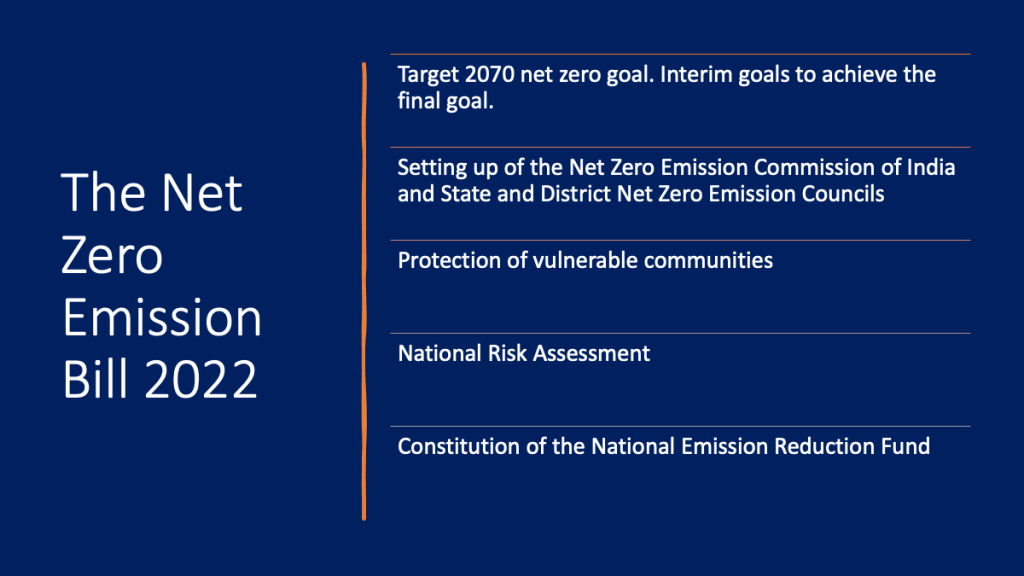
The Net Zero Emissions Bill 2022 was introduced in Rajya Sabha on December 9, 2022. It hasn’t received the attention that it deserves. The Bill creates a structure that will enable India to achieve the net zero target set out at the Glasgow Summit and incorporated in India’s NDCs (Nationally Determined Contributions). To achieve the 2070 target, Interim emission targets are set out:
(a) reduce by the year 2030 emissions intensity by forty-five per cent. from 2005 levels; (b) achieve about fifty per cent cumulative electric power installed capacity from non-fossil fuel-based energy resources by the year 2030, with the help of transfer of technology and low-cost international finance including from Green Climate Fund; (c) create an additional carbon sink of two and a half to three billion tonnes of carbon dioxide equivalent through additional forest and tree cover by the year 2030.
The Interim Emission Target shall be considered to have been achieved if emissions reductions meet or exceed those required by the target as per the 2005 levels.
The Bill envisages setting up the Net Zero Emission Commission of India. Similarly, State Net Zero Emission Councils and District Net Zero Emission Councils will be set up.
The Bill also provides for the protection of vulnerable communities. The State Councils and District Councils shall respectively maintain a localized climate-vulnerable community population registry. This classification will be based on the following:
(a) exposure to regional drastic climate variability; (b) (historical susceptibility to drastic climatic events according to available sources of climate information; (c) frequency of economic and non-economic loss suffered due to drastic climate events; (d) access to technology and risk perceptions systems and their awareness; (e) loss of livelihood and customary and cultural practices of communities; (f) specialized impact of climate change unique to a person or community
The Bill also provides for a National Risk Assessment. though (a) assessment of the risks to India’s economy, society, environment and ecology from the current and future effects of climate change; and (b) identification of the most significant risks to India based on the nature of the risks, their severity and the need for coordinated steps to respond to those risks in the next six-year period.
The Bill envisages the constitution of the National Emission Reduction Fund that shall be utilized for greenhouse gas emission reduction activities. Both the State and Central governments will fund this by a grant of loans.
All disputes will lie with the National Green Tribunal.
High inflation rates have persisted for quite some time now. As a result, inflation affects both (a) how businesses operate in a high inflation environment and (b) how consumers respond with their purchase decisions.
In an inflationary environment, businesses face higher costs due to increased input prices. Staff costs rise too as the company needs to compensate people for a higher cost of living. Nominal interest rates raise the cost of borrowing. While all costs are rising, businesses have limited capacity to pass on the cost increases. While the worker (who is also a consumer) receives higher wages, she does not get fully compensated for inflation. Thus, the worker or the consumer sees an effective reduction in her purchasing power. With tight demand, higher prices will only drive away the consumers. Add to this chaos consumer preference for sustainable products.
A study by GfK indicates that about 80% of consumers globally say that sustainability remains important to them. At the same time, about 30% of Europeans, 40% of people living in the US and 50% from developing Asia indicate that they will put their own economic security and wellbeing before environmental problems.
This makes reading the situation confusing. So what’s a company to do?
Finetune your messaging: Undertaking sustainable actions is not enough. These actions need to be communicated credibly too. Communication without action is easily caught out and can cause irreparable harm. For instance, if you are an appliance manufacturer, help the customer understand your repair and refurbish programme and make it easy for them to avail of it. Or, prevent food waste by providing discounts near expiry dates. Provide net zero labels that are easily visible or communicate net zero credentials powerfully on other mediums.
Build core sustainability capabilities: The customer’s view on sustainability has shifted from “cleaning up” to “saving the planet” – given the magnitude of the problem and increased awareness of sustainability issues. Thus, companies will need to continue to build a strategic focus on sustainability. Then, when inflation ebbs, the company will be ready to cater to customers opening up their wallets.
The opportunity for sustainable products is immense. Increase their perceived value, ensure its effective use and create compelling communication to build trust with the consumer.