A shorter version of this piece was originally posted on LinkedIn — this is the fuller version, with more detail on the study’s findings and the global regulatory picture.
More than half of major U.S. corporations quietly revise their reported emissions after the fact — and when they do, the errors overwhelmingly go in one direction: down. That’s the central finding of a new study in Nature Climate Change by Cohen, Rouen and Sachdeva, and it raises uncomfortable questions for anyone relying on corporate climate data — regulators, investors, and the companies themselves.
What the study found
The researchers examined a decade of Corporate Social Responsibility (CSR) reports from major U.S. firms, tracking how self-reported Scope 1 emissions changed between initial disclosure and later restatement. The pattern was remarkably consistent:
- 58–60% of firms’ self-reported Scope 1 emissions were later revised — a rate that has not meaningfully changed over ten years, despite growing regulatory and investor attention to climate disclosure.
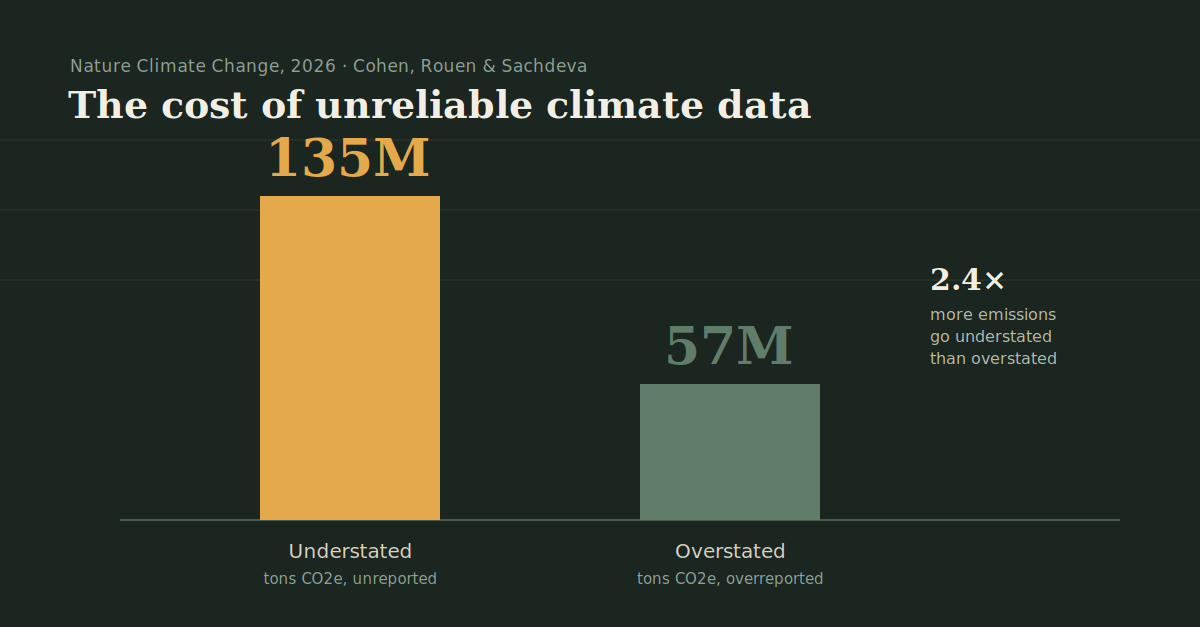
- Understatements outweigh overstatements by roughly 2:1. In a related analysis of S&P 500 companies, underreported emissions totalled approximately 135 million tons of CO2e, compared to about 57 million tons overreported — a net gap larger than the annual emissions of many mid-sized countries.
- Neither third-party assurance nor documented methodology changes fully explain the pattern. Companies that pay for external verification of their emissions data are not meaningfully less likely to revise it later.
- Data providers and ESG databases don’t consistently update when companies restate their numbers. This means outdated, incorrect figures can continue circulating in ESG scores, sustainability rankings, and investor models long after a company has quietly corrected them in a footnote.
Why this is happening
A few explanations emerge from the research and the broader literature on corporate disclosure:
There’s no audit function for emissions data the way there is for financial data. Financial restatements are rare and trigger real scrutiny — from auditors, regulators, and sometimes the SEC. Emissions restatements, by contrast, are common, largely unexplained, and often buried in a footnote or an updated appendix rather than flagged as a correction.
The measurement infrastructure is still maturing. Financial accounting has had roughly a century of standardisation, enforcement, and case law to work out consistent rules. Greenhouse gas accounting is comparatively young. Methodology changes, mergers and acquisitions, and shifting emissions-factor databases can all move historical numbers retroactively, and it’s not always clear from the outside whether a revision reflects better data or something else.
Incentive design may play a role. The study finds a suggestive—not conclusive—correlation between executive compensation tied to emissions targets and the direction of subsequent revisions: numbers move in a less favourable direction before a compensation link kicks in, and in a more favourable direction afterwards. This doesn’t prove manipulation, but it raises legitimate questions about how targets are set, measured, and audited when real money is riding on the outcome.
Why measurement accuracy matters beyond the numbers themselves
It’s tempting to treat this as a data-quality footnote. It isn’t. Emissions data is a foundational input into decisions with real consequences:
For policy design, carbon budgets, sector-specific regulations, and national climate commitments are all calibrated against baseline emissions figures. If those baselines are systematically off — especially if they’re skewed toward understatement, as this research suggests — governments risk setting targets that are too lax relative to the actual scale of the problem, or building compliance frameworks around numbers that don’t hold up to scrutiny.
For capital allocation, green financing, net-zero-aligned investment portfolios, and ESG-linked financial products all depend on emissions data to direct capital toward genuine climate performers. When the underlying numbers are unreliable, capital risks flowing to companies that look better on paper than in practice, while genuine leaders — who may report more conservatively or face more scrutiny — go underrecognized and undercapitalised. Bad data doesn’t just distort rankings; it can misdirect real money.
For corporate strategy itself, a company managing toward a flawed baseline can end up optimising for the wrong target — declaring victory on a reduction that was never real, or missing a risk that was hiding in the numbers all along.
The regulatory backdrop — and a global patchwork
This research lands at a pointed moment for U.S. climate policy. With the SEC’s climate disclosure rule shelved, the regulatory vacuum in the U.S. is increasingly being filled by other frameworks: California’s climate disclosure laws, the EU’s Corporate Sustainability Reporting Directive (CSRD), and the International Sustainability Standards Board’s (ISSB) global baseline standards. Multinational companies will need to navigate this patchwork regardless of what happens federally in the U.S.
The picture outside the U.S. is similarly mixed. In India, the Business Responsibility and Sustainability Reporting (BRSR) framework has driven a sharp increase in the volume of corporate emissions filings in recent years. But reviews from the Council on Energy, Environment and Water (CEEW) and CFA Institute (in partnership with CFA Society India and the National Stock Exchange) have flagged ongoing inconsistencies in data quality and comparability across companies, even as overall disclosure volume improves. No study equivalent to this one — tracking restatements over time — has yet been done for the Indian market, so it’s an open question how the same underlying dynamics play out there. Given the direction the U.S. data points, it would be surprising if similar issues weren’t present.
The bottom line
We are not measuring corporate emissions with anything close to the rigour we apply to corporate earnings — and the data suggests the errors aren’t randomly distributed. Until emissions accounting has the audit infrastructure, standardisation, and accountability that financial accounting has built up over decades, self-reported climate data should be treated as directionally useful rather than decision-grade, particularly for high-stakes uses like net-zero commitments, green financing, and regulatory compliance.
Sources: Cohen, Rouen & Sachdeva, “Widespread Revisions of Self-Reported Emissions by Major US Corporations,” Nature Climate Change (2025); CEEW issue briefs on BRSR and emissions disclosure; CFA Institute, “The Current State of BRSR at Corporate India” (2024).

