A shorter version of this piece was originally posted on LinkedIn — this is the fuller version, with more detail on each valuation channel, the study’s findings, and the practical implications for investors and CFOs.
Climate risk has moved from a sustainability footnote to a core driver of enterprise value. For years, it lived in corporate responsibility reports, ESG scorecards, and disclosure checklists — treated as a reputational or compliance matter rather than a financial one. That framing is now out of date. Climate risk alters expected cash flows, raises the cost of capital, and increases the probability of asset impairments and stranded assets. In other words, it moves the same levers that determine what a company is worth.
The clearest illustration of this shift is what happened to European utilities between 2010 and 2020. Over that decade, the sector wrote down more than €100 billion in fossil-fuel asset values, as rising carbon prices, tightening emissions regulation, and shifting demand patterns forced coal and gas plants into earlier retirement or sharply reduced running hours. These were not abstract climate projections playing out decades into the future — they were balance-sheet events, recognized in real time, that permanently reduced the value of assets that had been built to run for decades longer.
That example captures the argument of this piece in miniature: in practice, climate risk is often treated as a PR problem or a compliance problem. It is, first and foremost, a valuation problem.
Four Channels, One Destination: Enterprise Value
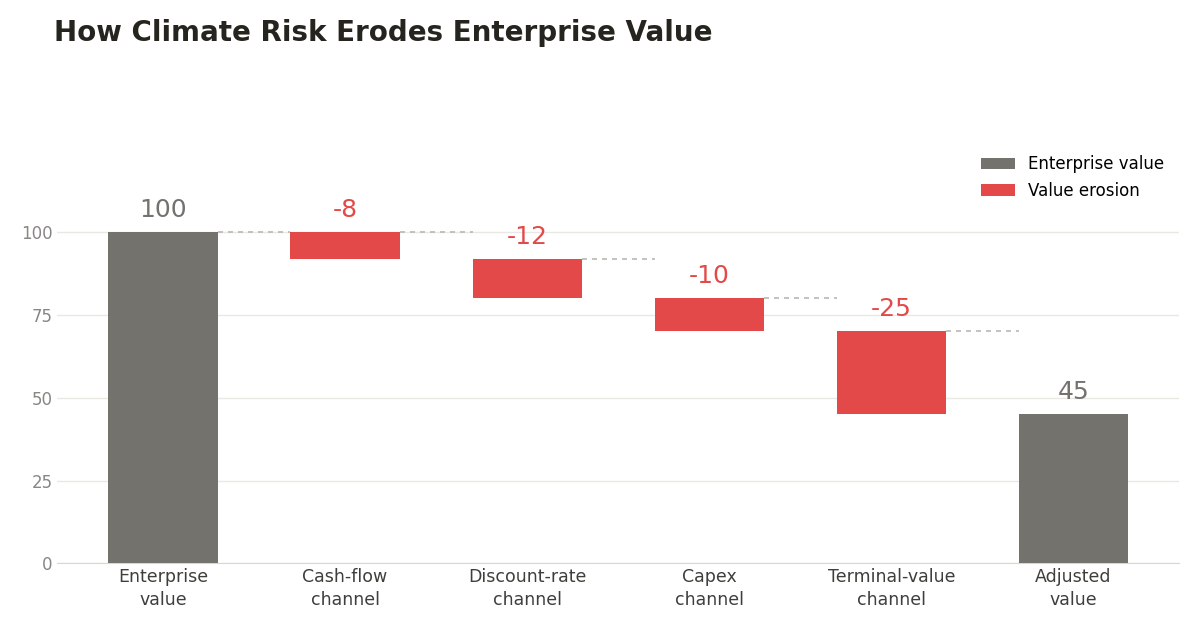
Climate risk does not affect company value through a single mechanism. It moves through at least four distinct channels, each of which feeds into the standard building blocks of valuation — cash flow, discount rate, capital expenditure, and terminal value.
The cash-flow channel. Physical risks — floods, heat stress, drought, supply-chain disruption from extreme weather — and transition risks — carbon pricing, technology shifts, tightening regulation — directly affect revenues, operating costs, capital expenditure needs, and working capital. A flood that shuts down a manufacturing site for weeks is a cash-flow event. A carbon price that rises faster than a company can decarbonize its operations is a cash-flow event. These are not hypothetical future risks; for many companies, they are already showing up in quarterly results.
The discount-rate channel. Investors price climate exposure through higher risk premiums and higher costs of equity and debt, particularly where the risks in question are non-diversifiable or poorly disclosed. A company operating in a flood-prone coastal region, or one heavily exposed to a carbon-intensive supply chain with no credible transition plan, looks riskier to the market — and that added risk shows up as a higher discount rate, which mechanically lowers the present value of every future cash flow the company generates.
The capex channel. Climate risk reshapes the level, timing, and riskiness of investment. Physical hazards and transition mandates force higher adaptation and decarbonization spending — flood defenses, electrification of fleets and facilities, emissions-control retrofits — while policy shifts and changing demand patterns can strand or defer long-lived projects that were planned under old assumptions. The result is higher near-term capital outflows and compressed free cash flow, both of which flow straight through to enterprise value.
The terminal-value channel. This is arguably the least discussed of the four channels, and often the largest. Stranded assets, climate-related litigation, and policy shocks compress long-run growth assumptions and shorten the effective useful life of assets. Because terminal value typically represents the majority of a discounted cash flow valuation — often 60 to 80 percent of total enterprise value in a standard DCF model — even a modest downward revision to long-run growth or asset life assumptions can have an outsized effect on the final number. This is why the European utilities writedowns were so large relative to the underlying operational disruption: the market wasn’t just repricing near-term cash flows, it was repricing the entire long-run trajectory of the business.
What the Evidence Shows
This is not just a theoretical framework. A 2026 study by Dell’Atti, Foglia, and Onorato found that higher climate-risk exposure correlates with lower market-to-book ratios and lower Tobin’s Q — a standard measure comparing a company’s market value to the replacement cost of its assets. Firms that ignore climate risk face measurable valuation discounts, while those with credible, well-disclosed transition strategies can command a valuation premium relative to peers.
This finding matters because it moves the conversation from should companies manage climate risk to are markets already pricing it in — and the answer, increasingly, is yes, at least where disclosure is good enough for investors to act on. That last qualifier is important: markets can only price risks they can see. Poor or inconsistent climate disclosure doesn’t eliminate the underlying risk, it just means the discount-rate channel operates with more noise and less precision, often defaulting to a higher risk premium simply because uncertainty itself is expensive.
One useful pattern worth watching: insurance markets tend to reprice physical climate risk well before equity markets do. Insurers have to underwrite specific, quantifiable physical exposures — flood zones, wildfire risk, hurricane paths — on an annual cycle, which forces faster repricing than equity analysts typically apply. When insurers start pulling back from a market or sharply raising premiums in a given region or sector, it is often an early signal of a valuation adjustment that equity markets have not yet fully made. For investors paying attention to physical risk, insurance pricing can function as a leading indicator.
Implications for Investors
For investors, the practical takeaway is to treat climate exposure as a factor that shifts both sides of the standard valuation equation: the numerator, in the form of expected cash flows, and the denominator, in the form of the discount rate applied to those cash flows.
This means integrating scenario-based cash-flow modeling rather than relying on a single base-case projection, and treating disclosure quality itself as a valuation signal rather than a compliance checkbox. Companies reporting under frameworks like the ISSB or TCFD standards are giving analysts the granular data needed to price climate uncertainty with more precision — which, all else equal, should translate into a lower risk premium than a company with vague or boilerplate climate disclosure. Investors and analysts increasingly use the quality of this disclosure as an input to the discount-rate channel directly.
It’s also worth building a habit of monitoring insurance market signals alongside equity research — not as a replacement for fundamental analysis, but as an early warning system for physical risk that hasn’t yet been reflected in share prices.
Implications for CFOs and Corporate Strategy
For CFOs and strategy teams, the priority is mapping transition and physical risks directly to the value chain — not as a standalone climate risk register, but as an integrated part of financial planning. That means quantifying cash-flow impacts under multiple climate pathways (not just a single central scenario), and explicitly aligning capital expenditure and portfolio decisions to avoid building or acquiring assets that carry meaningful stranding risk.
Credible transition plans matter here — not glossy sustainability reports, but plans with specific capital commitments, timelines, and interim targets that investors and rating agencies can actually underwrite. Alongside this, resilient and diversified supply chains help protect the cash-flow channel directly, reducing exposure to single-point physical disruptions.
The companies that get ahead of this are not necessarily the ones spending the most on climate initiatives — they are the ones that can clearly show analysts how those initiatives protect cash flow, reduce the discount rate applied to their equity, and preserve long-run terminal value.
The Bottom Line
Many argue that climate risk is still underpriced in equity markets relative to what physical risk models suggest it should be. That gap will not close on its own — investors must price it in deliberately, by demanding better disclosure and by treating climate exposure as a core financial variable rather than a sustainability initiative running in parallel to the “real” business.
Climate risk is not a line item. It is central to how a company is valued — through cash flows, through the discount rate, through capital allocation, and through the long-run assumptions that determine terminal value. The sooner that gets reflected in how companies report and how investors model, the sooner the mispricing starts to close.
Where do you see the biggest mispricing today: equities, credit, or insurance?
 Utkarsh Majmudar